From the War of the Roses to the Fun Ship
Where a king once escaped by boat and a ferry route came and went - the first in a series on the Irish Sea's most improbable ferry ports.

This post is the start of a mini series covering four of the more unlikely historical embarkation points for journeys across the Irish Sea.
In the course of my research, I have come across some surprisingly small places that have hosted ferry services over the years. Many of these have sadly been short lived.
In the course of this series I will cover ports in England, Ireland and Scotland, but I will start in Wales.
Mostyn (population 1,800)
The ‘Quay of Mostyn’ (now the Port of Mostyn) has had an eventful history, according to the Port’s website. Located on the River Dee in North Wales, with easy access to the Irish Sea, it has been strategically important, from the War of the Roses to the 21st century.
In 1485 Henry Tudor eluded capture at Mostyn Hall by Richard III, escaping by boat using Mostyn Quay before going on to defeat his foe at Bosworth Field.
Later, the Flintship port played a role in the English Civil War and by 1800s it was well positioned to support the industrial revolution. Keen to start iron production, Lord Mostyn commissioned the renowned engineer Thomas Telford to plan the quay’s modernisation. The combination of a colliery, iron works and a dock made the whole enterprise extremely successful, employing 1,900 people in its heyday.
The ironworks closed down in 1965, but the Port has continued to modernise progressively to accommodate larger and longer vessels. In 2001 / 2002 a 170m long roll on – roll off berth was developed. This allowed it to win the P&O passenger service contract, which switched from Liverpool in 2001.
With the fastest conventional ship on the Irish Sea serving the route, it cut one-and-a-half hours off crossing times to and from Dublin. Up to 405 passengers and their vehicles could cross the Irish sea in less than six hours.
‘Dredging situation’
But in May 2003, P&O announced it was to sell its routes and vessels at the ports of Liverpool, Fleetwood and Dublin to Stena Line. This was blamed on a lack of dredging of the port making services unviable.
“We needed to provide a regular timetabled service which hasn’t been possible because of the dredging situation,” P&O spokesman Stuart Walker told BBC Online at the time.
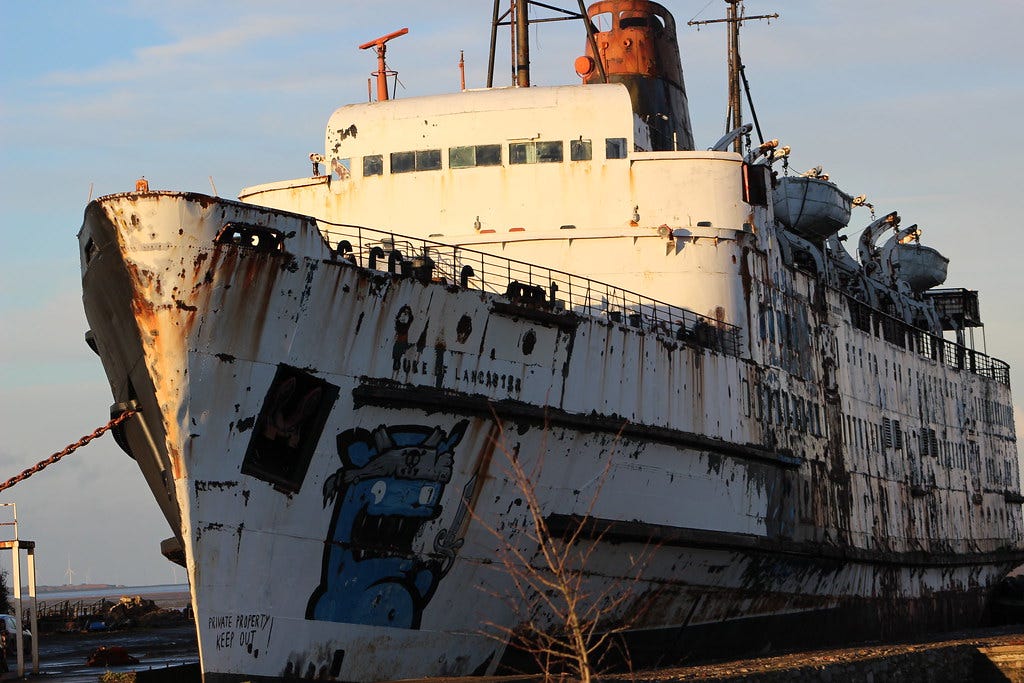
Around the time the ferry was axed, a chapter also closed for another ship associated with the town - Mostyn Fun Ship, which was moored just down the road from the port. The Fun Ship was formerly the Duke of Lancaster, which carried passengers and cars on the Holyhead - Dun Laoghaire route until the early 1970s1.
After a long planning battle with the local authority, the Fun Ship was finally abandoned by its owners. This put an end to a variety of attempts going back to the late 1970s to redevelop the former ferry as a leisure attraction.
Since then, it has featured in the BBC’s Coast in 2011 and its hull has attracted graffiti artists from around the world.
As of last year it was owned by the The Duke of Lancaster Appreciation Society and is still out of bounds to visitors and sadly rotting away. Some 50 arcade machines from the ship were sold in 2011 to collectors, a travel blogger reports.
‘1970s time capsule’
But according to this well-researched post, urban explorers who succeeded in boarding the boat have found its patterned carpets, padded bar and red velvet armchairs still intact, describing it as “a 1970’s time capsule”.
Despite the closure of the passenger ferry - and the failure to create north Wales’ answer to the Tuxedo Princess, -Mostyn’s port has remained in-demand. Since 2004, extensive areas of hard-standing have been developed in the port to allow it to serve offshore windfarm construction projects. And Mostyn also ships the wings for Airbus aircraft which are manufactured at Broughton.
Our next port of call will be across the Irish sea to a tiny coastal community with a big place in radio history.
Car Ferries of the Irish Sea 1954-2004, Justin Merrigan, p158
I'm from just the other side of the Dee: Neston on the Wirral. The neighbouring village of Parkgate, down on the waterside, saw its access to the Irish Sea silted up long before Mostyn (there was actually a school in Parkgate by the name of Mostyn House), but back in the day there was a packet boat service to Dublin, which Handel took on his way to the première of The Messiah in the Irish capital. Supposedly he did a hasty rewrite of some parts in his room at a Parkgate inn while waiting for his crossing.