The Tuxedo Princess - the boat that changed history
A celebration of the boat that revived the fortunes of an Irish Sea crossing and brought cheer to Tyneside.

Anyone who lived on Tyneside in the 1980s would know it. And if you watched the closing scenes of the iconic BBC TV series “Our Friends in the North” in the 1990s, you’d recognise it too.
I am talking about “The Boat”, the famous floating nightclub moored on the south bank of the Tyne close to the Tyne Bridge from 1984 to 2007.
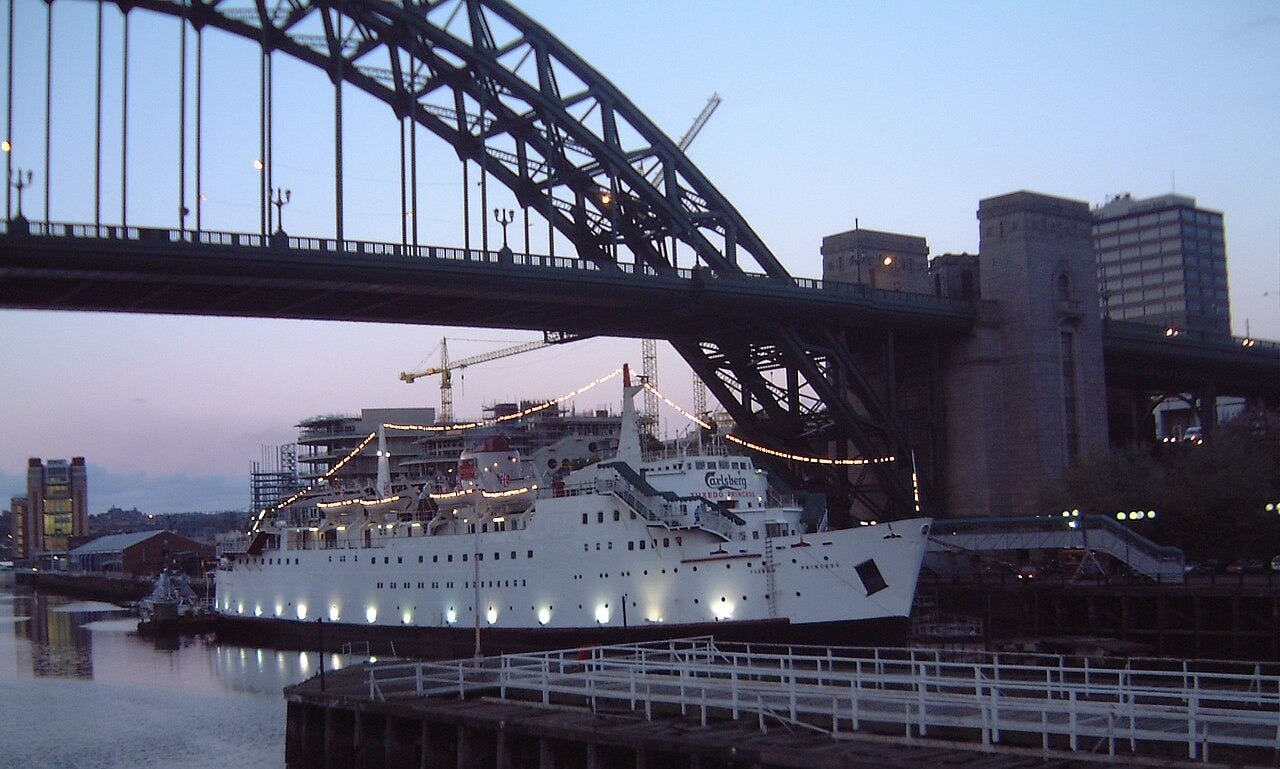
“The Boat” was actually two boats - the Tuxedo Princess and the Tuxedo Royale. Together they became a famous landmark on the Tyne and etched in the memory of many Geordies who braved their wobbly walkways after a few drinks.
Over the years they hosted celebrities, from Freddie Star to Frederik the Crown Prince of Denmark, featured in a Maximo Park video and was where Auf Wiedersehen Pet’s Tim Healy proposed to Loose Women’s Denise Welch. Cheryl Tweedy used to work on board before finding fame with Girl’s Aloud.
Luxurious touch
But although both boats are culturally significant to Geordies, this post is mostly about the Tuxedo Princess and its previous life. Originally the Caledonian Princess, she was built by Wm. Denny and Brothers of Dunbarton and at the time was seen as “a showpiece of Scottish shipping”. 1 Launched in 1961 she was known for the luxurious touch that other ships on Irish Sea routes lacked.
Ordered by the British Transport Board’s ferry arm (later known as Sealink) for the Stranraer - Larne route, the boat affectionately known as the ‘Caley P’ replaced the Princess Victoria which went down eight years earlier with the tragic loss of 134 lives off the Antrim coast2.
The impact of the Princess on Irish Sea passenger shipping is arguably just as significant as its impact on the culture of Tyneside. It was the ship that changed the Stranraer - Larne route’s fortunes. Traffic had declined during the 1950s on the route. At the end of the decade it was announced that British Rail was considering abandoning Larne and running the service to and from Belfast instead. It made one final throw of the dice to boost traffic with a new purpose-built roll-on-roll-off vessel. The Caledonian Princess brought an immediate transformation of the short sea route, which helped to increase its popularity over the next 35 years until the move from Larne to Belfast in 1995.3
‘A revolutionary ship’
Within two years of launch the profit on the ship had almost doubled to £370,000. By 1967 it had risen to £616,000.4 In his book Stranraer - Larne, the Car Ferry Era, Miles Cowsill described the Caley P as “a revolutionary ship” with innovations like a revolving car platforms. Meanwhile, Glasgow Herald hailed her as ‘a modern passenger liner’.
In the 1970s the Princess was used as a relief vessel on various routes including Holyhead to Dun Laoghaire, Heysham to Belfast. In 1981 she was withdrawn because she was steam powered, which by that time was uneconomical to run.
That’s when Michael Quadrini stepped in. The owner of the Newcastle nightclub the Tuxedo Junction, he snapped up the Princess after attempts to sell it for use in Nigeria failed. Lagos’ loss was Gateshead’s gain. Newcastle City Council wouldn’t grant a license so he took it across the river.
After a lick of white paint and a glow up, including converting the revolving car platform into a revolving dance floor, she made her debut in that high profile spot under the Tyne Bridge. And there she stayed, apart from a few years in the late 1980s and early 1990s when the former cross-channel ferry (also formerly Sealink) the Dover took over as “The Tuxedo Royale”.
‘Slightly naff’
Thousands of people could fit on the boat making it one of the biggest water-bourne leisure attractions in Europe at the time. In an interview for National World - Local TV, Dr Martin Farr. Senior Lecturer in Contemporary British History at the University of Newcastle, said the revolving dancefloor was considered “slightly naff”, but he said it was “a selling point”.
By 2007, the former car ferry was starting to look distinctively tatty on Gateshead’s regenerated quayside, now with a concert venue and an art gallery. The quayside area vacated by the Tuxedo Princess was to be redeveloped into a leisure, restaurant and office complex. At the time of writing there is a brewpub and bikeshop inside repurposed shipping containers on the site. The boat itself was removed and later scrapped.
I never boarded ‘The Boat’ while it was a nightclub. As an adult, I wasn’t into the commercial dance music that rocked the revolving dancefloors. I don’t ever remember any of my friends suggesting we go there - on nights out we mostly stayed on the Newcastle side of the river. But ‘The Boat’ was a familiar sight for most of my childhood and well into my 20s. Even now, it makes me think of home. That white boat seen through the eyes of Daniel Craig walking across the bridge to a soundtrack of Oasis symbolises the river Tyne to millions around the world. Long after it departed the river, The Tuxedo Princess’s place in Tyneside’s cultural folklore is well-earned.
Cowsill, Miles, Stranraer-Larne The Car Ferry Years, p14
Cowsill, Miles, Stranraer-Larne The Car Ferry Years, pp 12, 13
Liddle, Lawrence, Passenger Ships of the Irish Sea 1919-1969, p21
Cowsill, Miles, Stranraer-Larne The Car Ferry Years, p45
Radio football commentary legend Mick Lowes had his first BBC leaving do on the boat. Epic.
Thanks for the history of the Princess, an icon on the river for many years. I only went a few times - for office do's, my mates wouldnt be seen dead walking up the gangway!