Grain, granite and golf
How a Victorian dock, built in a land of feuding and pillage, has been kept alive by a biscuit maker's need for flour.

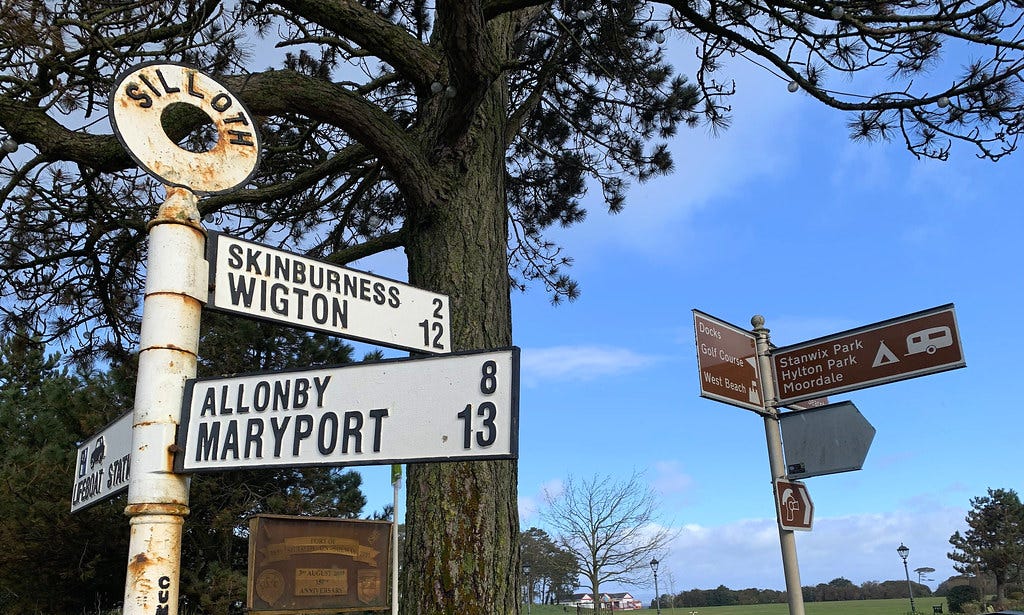
Like many border areas, the Solway Firth has a violent history. The firth that forms part of the border between England and Scotland was a staging point for Edward I’s invasion of Scotland, his vessels stationed off the shore.
Then, between the fourteenth and seventeenth century, some border communities were the victims of cattle rustling, feuding, murder, arson and pillaging. The perpetrators were the Reivers, families spanning both sides of the border who resorted to lawlessness to make their living.
Once these disputes calmed down, a small coastal hamlet on the firth grew to become an important transport node linking farming communities in Ireland, Scotland and northern England. This town takes its name from silos known as ‘lathes’, where Cistercian monks stored their grain, becoming known as Silloth.
Personal connection
None of the places already featured in the unlikely ports mini-series on my Substack were ones I had visited before. But Silloth is a place I have been to, although it was only a brief encounter as a very young child. This personal connection, however brief, makes discovering this town’s hidden maritime history even more exciting.
Transport was the key to the area’s fortunes and decline. Previously, a canal linked the city of Carlisle to its nearby port. But by 1854 the canal had been filled in and a railway built in its place, which extended westwards to a new port and docks at Silloth.
The railway serving the town overcame opposition to its route through sand hills and rabbit warrens, opening in August 1856. This was followed by the construction of a dock protected by a 300m long pier. The first ship entered in 1859 marking the start of an 80 year regular sea connection between Silloth and Ireland.
Silloth became a vital link for both passengers and goods between northwest England and Ireland, trading coal and livestock. Most notably, it served Dublin, but Belfast, the Isle of Man, and even Liverpool were also key destinations.
The Liverpool steamer was particularly important for carrying cotton to the local mills. By the late 1870s, north American wheat began arriving mainly for Carr’s, the biscuit makers in Carlisle.
From 1893, The Yarrow, operated a regular service for passengers and freight to the Isle of Man and Dublin1. The Yarrow had the conventional nineteenth century layout of passenger accommodation with saloon passengers (first class) after and third class forward.
Cattle carrier
However, humans were arguably the least important passengers on board. According to Laurence Liddle, the ship was “more of a cattle carrier than a passenger vessel”, with the Yarrow providing the most direct route from Ireland to the cattle markets in Carlisle and the south of Scotland.2
The service from Dublin to Silloth continued until 1942. Initially World War 2 had little effect on the services but the Yarrow, now renamed the Assaroe, was transferred to a route between Dublin and Lisbon. During this war the Admiralty classified Silloth as a “Safe Port,” and it handled thousands of tons of coal. After the war, a regular service was not reinstated. Occasional shipments of cattle travelled from Dublin to Silloth until the 1970s.
Today Silloth plays an important role importing agricultural products for the region’s farming industry. The grain still comes in, as it always has, imported and discharged directly into Carr’s Flour Mills on the north side of New Dock. A storage and distribution facility for prime molasses is located at the port, capable of storing up to 6,000 tonnes of molasses.
But like Greenore, which featured in the previous Substack, Silloth embraced tourism in Victorian times welcoming daytrippers from Carlisle who came to enjoy its milder climate and seaside location.

Today it continues to welcome visitors with its “wide elegant tree lined streets, magnificent promenade... with scenic views across the Solway Firth to the Dumfries & Galloway Hills in southern Scotland, and spacious sea front Green”.
The town is home to a 18 hole natural links golf course, reputed to be one of the most attractive and testing in the north of England. Silloth Green was recently awarded a prestigious Green Flag after achieving international quality mark for parks and green spaces.
Although there is no longer a regular ferry to Dublin, Silloth’s Irish links have not entirely disappeared from the town. The most impressive is found in its ornate Christ Church, which was designed by a Carlisle man and built in the 1870s of granite - imported from Ireland.
Christ Church’s Irish stone is, in its way, a more permanent link than the ferry ever was. A crossing made once, in one direction - and never needing to return.
Passenger Ships of the Irish Sea 1919-1969, Laurence Liddle, p67
Passenger Ships of the Irish Sea 1919-1969, Laurence Liddle, p67